







Art & interiors
Three Art Prints: Build a Row with Rhythm

A set of three art prints can read as one arrangement while leaving each artwork independent. This guide builds an even row from two Vitor Costa abstractions and Blue Line Face by Athene Fritsch. The task is to organise three different voices, not to make them look like fragments of a single picture.
Choose the job of the middle picture
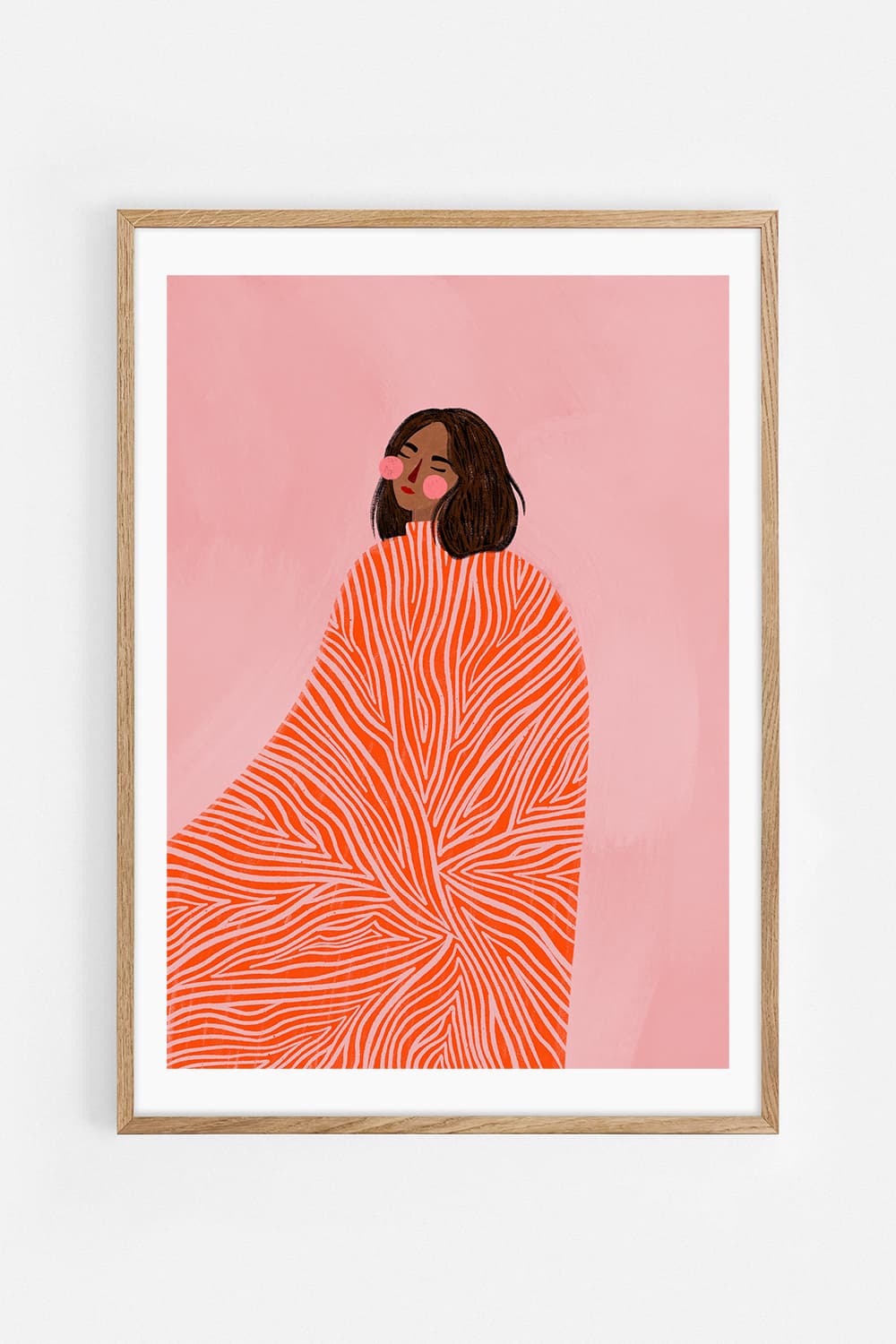
White lines I brings a broad cream curve and White lines II a more broken blue pattern. Blue Line Face gives the row a recognisable face and a quieter white ground. In the middle, that open ground can create a pause. Test the reverse logic too: a stronger central block can work where the furniture below already feels symmetrical.
Call the combination what it is
These are three separate artworks by two artists, combined for this example. They are not an original triptych painted as one work, and no three-piece bundle is implied. Keep all artist credits visible and check each product selection separately. That distinction helps you choose works for their relationship rather than expecting one continuous scene.
Calculate the whole row
Three 30 × 40 cm portrait prints and two 6 cm gaps need 102 cm of width before adding the frames. At 50 × 70 cm, the same calculation gives 162 cm before frames. Use the outside frame widths for the real layout. A row that looks small on a screen can quickly outgrow a short bookcase.
Choose one line to align
With equal frames, align their top edges and keep the gaps consistent as a first test. Resist adjusting one picture to compensate for its internal white space until you have stepped back. Different marks can sit inside a calm outer rectangle. Judge from the doorway and the usual reading chair, not only at arm’s length.
Make changes in a useful order
First change the sequence of the pictures. Then try a different gap. Only after those tests should you vary a print size or add another frame finish. Changing all three things together makes it hard to identify what improved the composition. Photograph two alternatives from the same position so the comparison stays fair.
Leave the ends of the row clear
A tall reading lamp or a pile of books can make one end feel heavier. Move those objects before concluding that the art needs a fourth piece. Let the row sit within the usable furniture zone, and choose wall fixings for the real frame and wall. The room image illustrates the arrangement rather than installation details.
Questions about this layout
Can three prints have different sizes?
Yes. Test their complete outline with paper templates. Equal sizes simply provide the clearest starting point for this row.
Is this a ready-made triptych?
No. The example combines separately offered works by Vitor Costa and Athene Fritsch.
 White lines I
 Blue Line Face
 White lines II